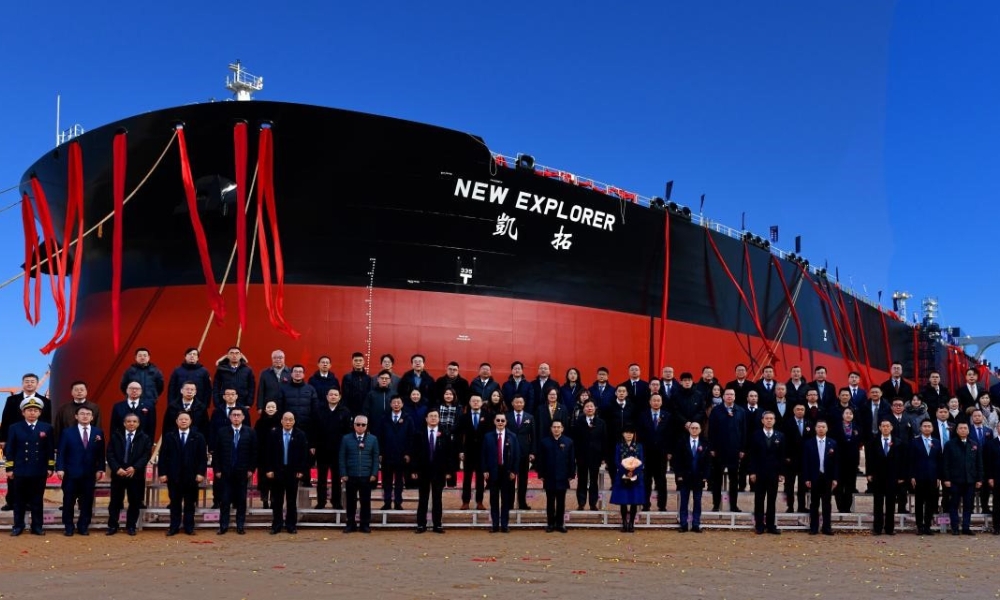
The China Classification Society (CCS) on Monday (22 December) said Dalian Shipbuilding, a part of China State Shipbuilding Corporation (CSSC), delivered a methanol dual-fuel very large crude carrier (VLCC) to China Merchants Shipping.
This milestone marked the world’s first methanol dual-fuel VLCC to officially enter commercial service.
This vessel is the eighth-generation VLCC independently developed by Dalian Shipbuilding and is classed by the China Classification Society (CCS).
Equipped with a domestically produced methanol dual-fuel main engine and a methanol fuel supply system, the vessel can reduce carbon dioxide emissions by up to 92%, 99% in sulphur oxide emissions, and 90% in particulate matter compared to vessels powered by conventional fossil fuels.
It has an overall length of approximately 333 meters and a crude oil carrying capacity of around 2.1 million barrels. Boasting superior performance attributes including excellent seaworthiness, strong port adaptability, low emissions, and smart operations, it features a shallower full-load draft than conventional VLCCs. This design not only significantly enhances navigation convenience through the Malacca Strait, but also greatly improves its port compatibility.
Furthermore, the vessel integrates self-developed on-board intelligent platforms. These include an intelligent liquid cargo control system and an intelligent engine room operation and maintenance system. These systems collectively boost the economic efficiency, operational efficiency, and safety of the vessel.
In particular, the intelligent liquid cargo control system integrates over ten subsystems related to crude oil loading, unloading, and transportation, providing core functions including multi-system coordinated control, intelligent cargo handling operations, and expert knowledge-based decision support.
Photo credit: China Classification Society
Published: 5 January, 2026