Iberia led the largest increase in LNG supply to ships recorded in the entire European port system, drastically closing the gap that separated it from the dominance of the Netherlands, according to Gasnam recently.
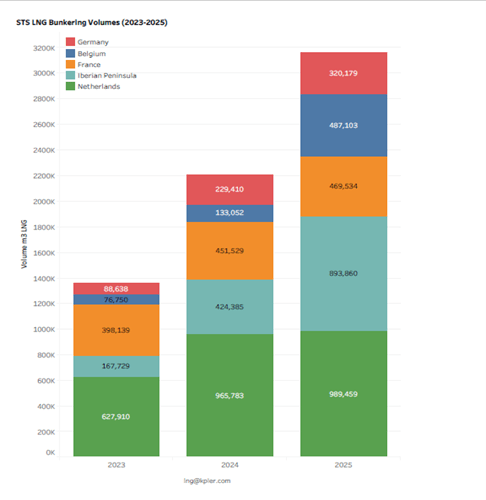
In the ports of the Peninsula, the supply of LNG to ships has quadrupled in just two years, reaching 893,860 cubic meters last year, double that of 2024; while in the Netherlands growth remains stable, having registered 989,459 cubic meters in 2025, only 2% more than the previous year.
“The evolution recorded between 2023 and 2025 indicates that, if the current trend continues, the Iberian Peninsula is positioned to become the European leader in LNG supply to ships in 2026,” Gasnam said.
This progress is supported by the rapid expansion of STS bunkering and the resilience of its distributed logistics network.
The Dutch model concentrates most of the LNG bunker in the port of Rotterdam. In the case of the Iberian Peninsula, it has demonstrated the strength of a system supported by multiple nodes in strong growth —Algeciras, Barcelona, Bilbao, Cadiz, Cartagena, Gibraltar, Huelva, Malaga, Tenerife, Sines and Valencia—, which make up a diversified and especially competitive supply network in ship-to-ship (STS) operations.
“The future of global maritime transport is being decided today on the Iberian Peninsula. We not only have the location, but we have also demonstrated that we have the infrastructure and production capacity to lead Europe,” said Eugenia Sillero, Secretary General of Gasnam.
Photo credit: Chris Pagan on Unsplash / Kpler
Published: 23 February, 2026