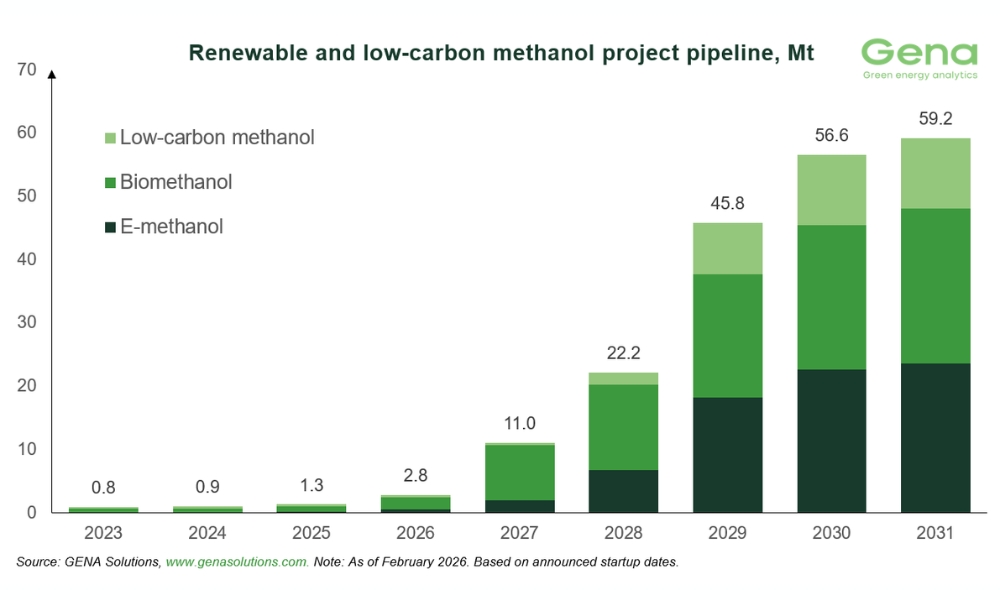
The Methanol Institute recently shared with Manifold Times the renewable and low-carbon methanol project pipeline February 2026 release produced by GENA Solutions Oy.
Information from the release is meant to provide the bunkering publication’s readers with insight on renewable methanol availability, and to assist the maritime industry in the adoption of methanol as a mainstream marine fuel heading into IMO 2030/2050.
Key highlights from GENA’s February 2026 Methanol release are as follows:
- As of February 2026, Project Navigator Methanol tracks 277 renewable and low-carbon methanol projects totaling 59.2 Mt by 2031, including 23.5 Mt of e-methanol, 24.5 Mt of biomethanol, and 11.2 Mt of low-carbon methanol.
- The renewable methanol project pipeline increased by 0.9 Mt compared to the previous month. Six projects were added in the current release, while three frozen projects were excluded.
- China and Europe lead e-methanol development (10.1 and 7.7 Mt, respectively), while China dominates biomethanol projects (18.5 Mt). North America remains the clear leader in low-carbon methanol development, with around 10.7 Mt of projects.
- During the past 12 months, GENA registered more than 15 Mt of new biomethanol and e-methanol projects. Together with challenges in advancing many projects to engineering and construction, this resulted in a high share of projects in feasibility or pre-feasibility: 81% for e-methanol and 78% for biomethanol.
- With most new projects based in China and Europe, the share of feasibility-stage projects in these regions is even higher than globally: 86–87%.
- We expect that several projects will reach FID or start construction during 2026, while many more will be frozen or delayed beyond their announced schedules. As a result, global renewable methanol capacity could reach 5 to 12 Mt by 2030, depending on demand and regulatory scenario development.
Note: The full article can be viewed here.

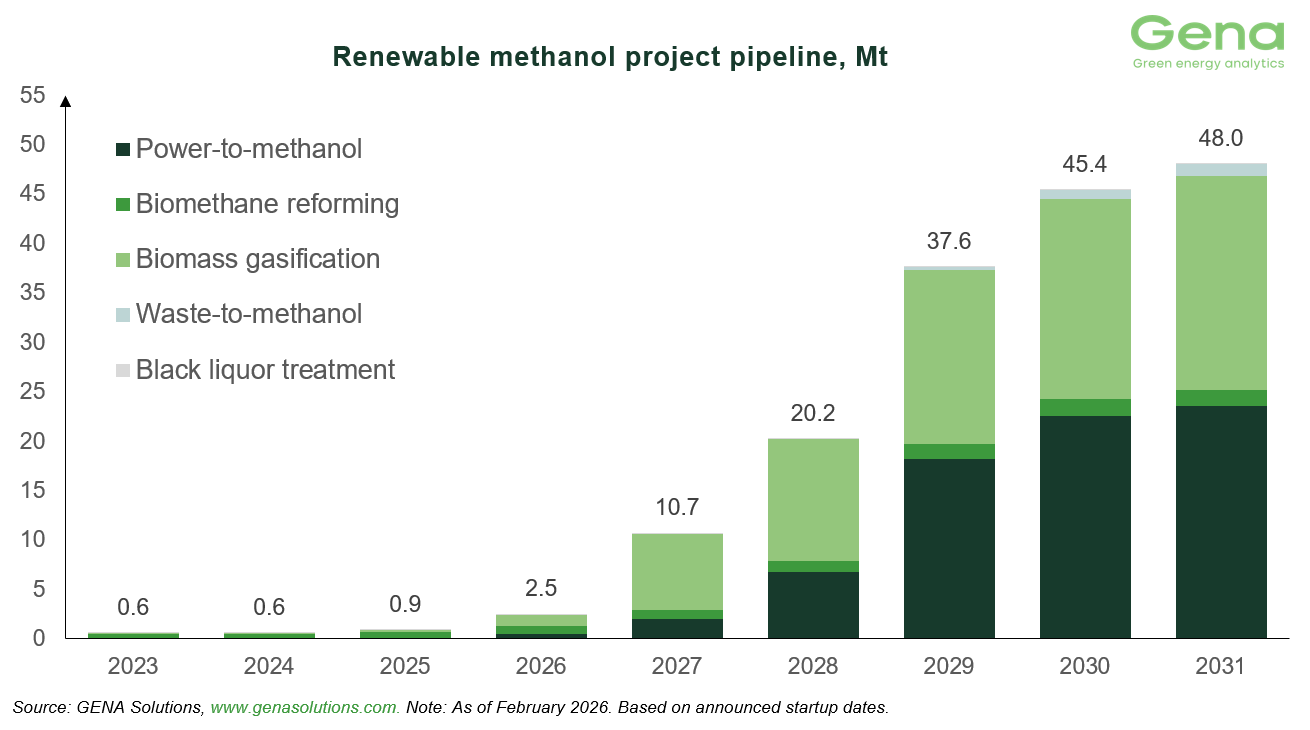


Photo credit: GENA Solutions
Published: 3 March, 2026