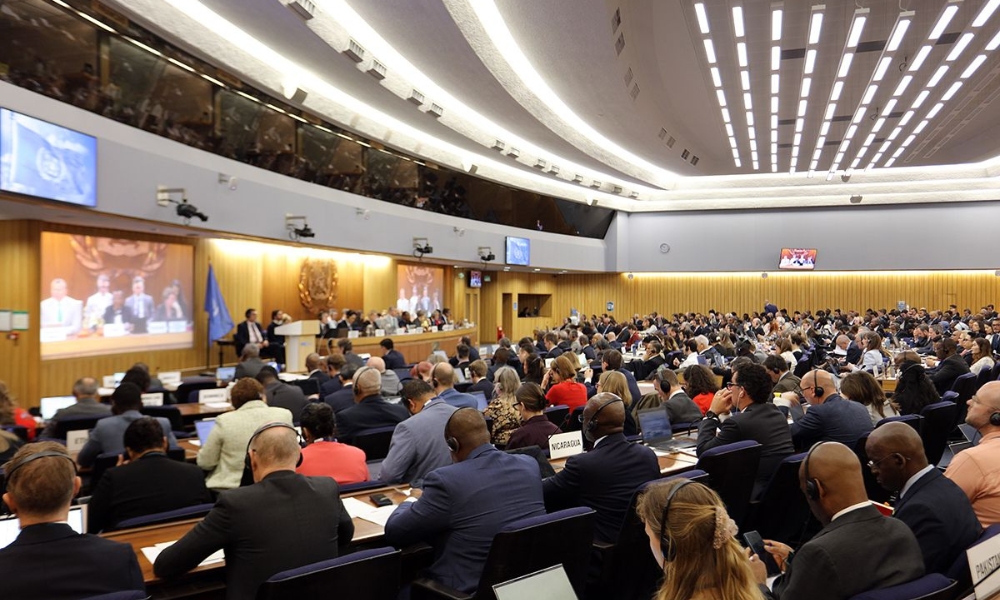
The International Maritime Organization (IMO) on Thursday (29 January) said its Sub-Committee on Ship Design and Construction (SDC) has finalized a workplan to develop a safety regulatory framework for ships using new technologies and alternative fuels to reduce greenhouse gas emissions.
The draft workplan will be submitted to the Maritime Safety Committee (MSC 111) for approval in May 2026.
The workplan will involve developing or amending existing safety regulations related to nuclear power; wind-propulsion and wind-assisted power; and lithium-ion batteries and swappable traction battery containers on ships, that are under the purview of the SDC Sub-Committee.
Closing the 12th session of the Sub-Committee, which met from 19 to 23 January in London, IMO Secretary-General Arsenio Dominguez said the completion of the work plan was a “major achievement”.
He added: “This will ensure that safety considerations evolve in parallel with the rapid technological progress driven by the IMO’s Strategy on the Reduction of GHG Emissions from Ships”.
Once the draft workplan is endorsed by the Maritime Safety Committee, IMO will work towards key milestones, including:
- 2028 (MSC 111): Adoption of amendments to SOLAS regulation II-1/41 to allow for batteries to be used as the main source of electrical power and lighting systems.
- 2029 (MSC 116): Approval of interim guidelines for the safety of ships using wind propulsion and wind-assisted power.
- 2030 (MSC 118): Adoption of the revised Nuclear Code and amendments to SOLAS chapter VIII.
The Sub-Committee established the SDC Correspondence Group on GHG Safety to compile and analyse information related to nuclear and wind power, as well as develop draft amendments to SOLAS regulation II-1/41 to allow for batteries to be used as the main source of electrical power and lighting systems.
The Correspondence Group will submit a written report to the next session of the Sub-Committee (SDC 13) in 2027.
Note: Read the full meeting summary of SDC 12.
Photo credit: International Maritime Organization
Published: 2 February, 2026